Your Induced fit model of enzyme action images are ready in this website. Induced fit model of enzyme action are a topic that is being searched for and liked by netizens now. You can Download the Induced fit model of enzyme action files here. Download all free vectors.
If you’re looking for induced fit model of enzyme action pictures information connected with to the induced fit model of enzyme action keyword, you have visit the ideal blog. Our site frequently gives you hints for refferencing the maximum quality video and picture content, please kindly search and find more informative video content and graphics that fit your interests.
Induced Fit Model Of Enzyme Action. Shape of active site changes as. The induced-fit model was first proposed by Koshland in 1958 to explain the protein conformational changes in the binding process. This brings the substrate closer to the higher energy transition state needed for the reaction to occur for instance by weakening its bonds so that it. Answered 6 years ago Author has 180 answers and 289K answer views.
 What Is Enzyme In Biology Structure Location And Function In 2021 Biology Enzymes Life Science From pinterest.com
Before reaction active site not complementary todoes not fit substrate. The substrate fits a particular active site like a key fits into a particular lock. The alternative induced fit model borrows a terminology that was initially coined to describe the emergent enzymatic activity resulting from the induction of an activated state Koshland et al 1966. The Lock and Key Model. Conversely in the lock and key model the catalysis. 2 marks Click card to see definition.
With the induced fit model the way that the substrate has to change its structure may be useful in terms of the catalysis itself.
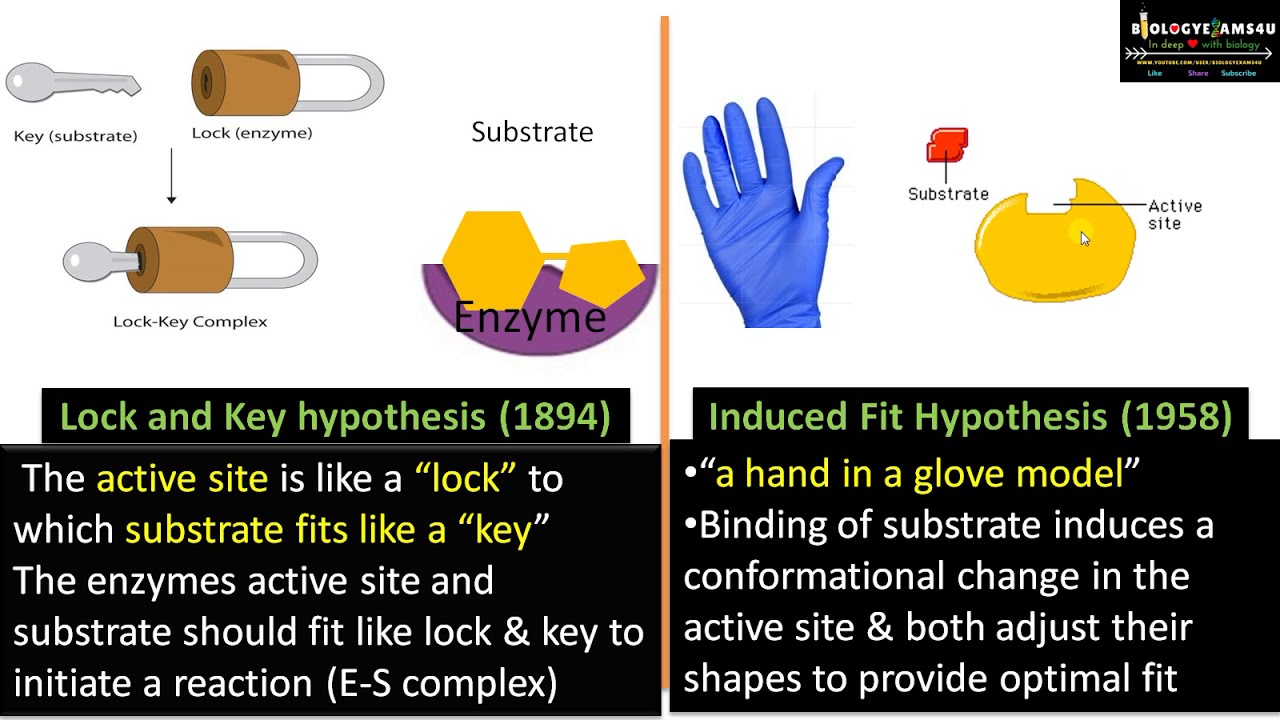
The Induced fit model describes the formation of the E-S as a result of the interaction between the substrate and a flexible active site. This is similar to placing your hand in a glove. His theory asserts that when the active site on the enzymes makes contact with the proper substrate the enzyme molds itself to the shape of the molecule. Briefly describe the difference between the lock-and-key model of enzyme action and the induced-fit model of enzyme action in your own words. A theory called the. The substrate produces changes in the conformation on the enzyme aligning properly the groups in the enzyme.
Source: pinterest.com
According to the lock and key model the enzymes active site complements the substrate precisely. Induced fit model of enzyme is described in this video lesson. Ie certain properties of enzymes cannot be accounted for by the simple relationship between enzyme and substrate proposed by the keylock hypothesis. According to the induced-fit model of enzyme activity this binding changes the conformationor shapeof both the enzyme and the substrate. There are two models used to describe the way enzymes interact with substrates.
 Source: pinterest.com
The induced fit model essentially states that enzyme-substrate binding is not like two puzzle pieces perfectly linking together but more like a hand fitting into a glove assuming the enzyme isnt in the OJ superfamily. This question hasnt been solved yet Ask an expert Ask an expert Ask an expert done loading. Answered 6 years ago Author has 180 answers and 289K answer views. Induced-fit model - an offshoot of the earlier lock-and-key model. The Induced fit model describes the formation of the E-S as a result of the interaction between the substrate and a flexible active site.
 Source: pinterest.com
It may represent the beginning of the reaction that the enzyme is catalyzing. On the other hand the lock and key model refers to a second model for enzyme-substrate interaction in which the active site of the enzyme completely fits with the substrate. Rather the substrate induces a change of shape in the enzyme. Consequently an enzyme reduces the activation energy of biological reaction which it catalyzes. In this video we take a look at the two different models or hypotheses for how enzymes function.
 Source: pinterest.com
Consequently an enzyme reduces the activation energy of biological reaction which it catalyzes. The substrate fits a particular active site like a key fits into a particular lock. The substrate produces changes in the conformation on the enzyme aligning properly the groups in the enzyme. Lock and key model - theory proposed by. According to the lock and key model the enzymes active site complements the substrate precisely.
 Source: pinterest.com
The substrate fits a particular active site like a key fits into a particular lock. States that the substrate induces a change of shape in the enzyme. The induced fit model can be broken down into the following stages. This theory maintains that the active site and the substrate are initially not perfect matches for each other. 2 marks Click card to see definition.
 Source: pinterest.com
According to the Induced Fit Model when substrate molecules bind to the active site of enzyme they induce some structural changes in the active site so that it can effectively bind the substrate molecules. Show transcribed image text Expert Answer. Ie certain properties of enzymes cannot be accounted for by the simple relationship between enzyme and substrate proposed by the keylock hypothesis. The keylock hypothesis see above The nature of enzyme-catalyzed reactions does not fully account for enzymatic action. The induced-fit model proposed by Daniel Koshland in 1958 attempts to explain how this is accomplished.
 Source: pinterest.com
This brings the substrate closer to the higher energy transition state needed for the reaction to occur for instance by weakening its bonds so that it. The Lock and Key Model. Conversely in the lock and key model the catalysis. Shape of active site changes as. This model of enzyme action was proposed by Daniel E.
 Source: pinterest.com
Answered 6 years ago Author has 180 answers and 289K answer views. Enzymes have very precise shape which includes a cleft or pocket called active sites. The induced-fit model proposed by Daniel Koshland in 1958 attempts to explain how this is accomplished. With the induced fit model the way that the substrate has to change its structure may be useful in terms of the catalysis itself. According to this theory confirmation of the active site modifies into a correct shape.
 Source: pinterest.com
There are two models used to describe the way enzymes interact with substrates. Lock and key model - theory proposed by. The induced-fit model is generally considered the more correct version. It may represent the beginning of the reaction that the enzyme is catalyzing. Answered 6 years ago Author has 180 answers and 289K answer views.
 Source: pinterest.com
This theory maintains that the active site and the substrate are initially not perfect matches for each other. According to this theory confirmation of the active site modifies into a correct shape. The induced fit is a theory that explains the binding of a substrate into an active site of an enzyme that does not have a correct conformation with that of the active site. These are called the lock and key model and the induced f. Rather the substrate induces a change of shape in the enzyme.
 Source: pinterest.com
These are called the lock and key model and the induced f. It may represent the beginning of the reaction that the enzyme is catalyzing. Lock and key model - theory proposed by. The alternative induced fit model borrows a terminology that was initially coined to describe the emergent enzymatic activity resulting from the induction of an activated state Koshland et al 1966. The induced fit model essentially states that enzyme-substrate binding is not like two puzzle pieces perfectly linking together but more like a hand fitting into a glove assuming the enzyme isnt in the OJ superfamily.
 Source: in.pinterest.com
2 marks Click card to see definition. The alternative induced fit model borrows a terminology that was initially coined to describe the emergent enzymatic activity resulting from the induction of an activated state Koshland et al 1966. Enzymes have very precise shape which includes a cleft or pocket called active sites. The induced-fit model is generally considered the more correct version. Consequently an enzyme reduces the activation energy of biological reaction which it catalyzes.
 Source: pinterest.com
According to this theory confirmation of the active site modifies into a correct shape. Laboratory Techniques in Biochemistry and Molecular Biology 1999. This model of enzyme action was proposed by Daniel E. 2 marks Click card to see definition. A theory called the.
 Source: pinterest.com
This model suggests that an enzyme when binding with its substrate optimizes the interface through physical interactions to form the final complex structure. This model suggests that an enzyme when binding with its substrate optimizes the interface through physical interactions to form the final complex structure. Shape of active site changes as. These are called the lock and key model and the induced f. Show transcribed image text Expert Answer.
 Source: pinterest.com
The induced fit model essentially states that enzyme-substrate binding is not like two puzzle pieces perfectly linking together but more like a hand fitting into a glove assuming the enzyme isnt in the OJ superfamily. States that the substrate induces a change of shape in the enzyme. The lock and key model. The Induced Fit model. Shape of active site changes as.
 Source: pinterest.com
The substrate fits a particular active site like a key fits into a particular lock. This is similar to placing your hand in a glove. With the induced fit model the way that the substrate has to change its structure may be useful in terms of the catalysis itself. Induced-fit model - an offshoot of the earlier lock-and-key model. The induced-fit model refers to a model for enzyme-substrate interaction in which the active site of the enzyme does not completely fit to the substrate.
 Source: pinterest.com
This brings the substrate closer to the higher energy transition state needed for the reaction to occur for instance by weakening its bonds so that it. The lock and key model. This model suggests that an enzyme when binding with its substrate optimizes the interface through physical interactions to form the final complex structure. The induced fit model essentially states that enzyme-substrate binding is not like two puzzle pieces perfectly linking together but more like a hand fitting into a glove assuming the enzyme isnt in the OJ superfamily. According to the lock and key model the enzymes active site complements the substrate precisely.
 Source: pinterest.com
Describe the induced fit model of enzyme action. Rather the substrate induces a change of shape in the enzyme. The substrate fits a particular active site like a key fits into a particular lock. Tap card to see definition. This is similar to placing your hand in a glove.
This site is an open community for users to share their favorite wallpapers on the internet, all images or pictures in this website are for personal wallpaper use only, it is stricly prohibited to use this wallpaper for commercial purposes, if you are the author and find this image is shared without your permission, please kindly raise a DMCA report to Us.
If you find this site adventageous, please support us by sharing this posts to your own social media accounts like Facebook, Instagram and so on or you can also save this blog page with the title induced fit model of enzyme action by using Ctrl + D for devices a laptop with a Windows operating system or Command + D for laptops with an Apple operating system. If you use a smartphone, you can also use the drawer menu of the browser you are using. Whether it’s a Windows, Mac, iOS or Android operating system, you will still be able to bookmark this website.


